Notes on the NIH
Some notes on the history of the NIH, and how it came to be the way it is today.
NIH's origins were in the national hygiene lab, minimally staffed.
Initial budget was $150M for 5 years, inflation adjusted. The initial proposal was developed with a Louisiana senator, and it was haggled down to ~$10M during the Great Depression in 1930. Herbert Hoover was a strong supporter. The hygiene lab was initially not on board. They wanted to remain a small but independent organization and had been fighting for a long time to avoid being swallowed into a bigger bureau. Ultimately, the hygiene lab went along in exchange for some pork in the form of larger salaries for research scientists.
Of the proposed budget, $5M was to be spent on a new lab, and $2M per year over a five-year period was meant to construct a new and enlarged lab. This doesn't make sense. The original proposal put it under the jurisdiction of the U.S. Public Health Service, controlled by the surgeon general, and authorized it to accept donations of up to $500k.
The initial NIH was a product of timing: it came on the heels of the 1928 flu pandemic and pitched some preliminary, exciting results in cell culture that proved useful. Originally it was very much focused on solving the government's public health problems. For example, ~40% of draftees couldn't be soldiers, and the #1 cause was tooth problems. So the NIH was created in 1930, and one of its first projects in 1931 was developing a strategy to fluoridate drinking water.
The initial seed of the NIH as today's umbrella mega-organization came in 1937, when the Senate unanimously cosponsored the creation of the National Cancer Institute. This new cancer mandate was promptly superseded. World War II shortly followed and shifted the main preoccupations to occupational exposure to lead and explosives, tropical diseases, and venereal disease.
In the postwar world, NCI was formally put under the control of the NIH. In the late 1940s, the NIH pluralized its name to the National Institutes of Health, and key changes started to happen:
- Divisions were named after diseases, not scientific disciplines: the “National Microbiological Institute” became the “National Institute of Allergy and Infectious Diseases.” Naming divisions after specific problems and diseases made them easier to get funded.
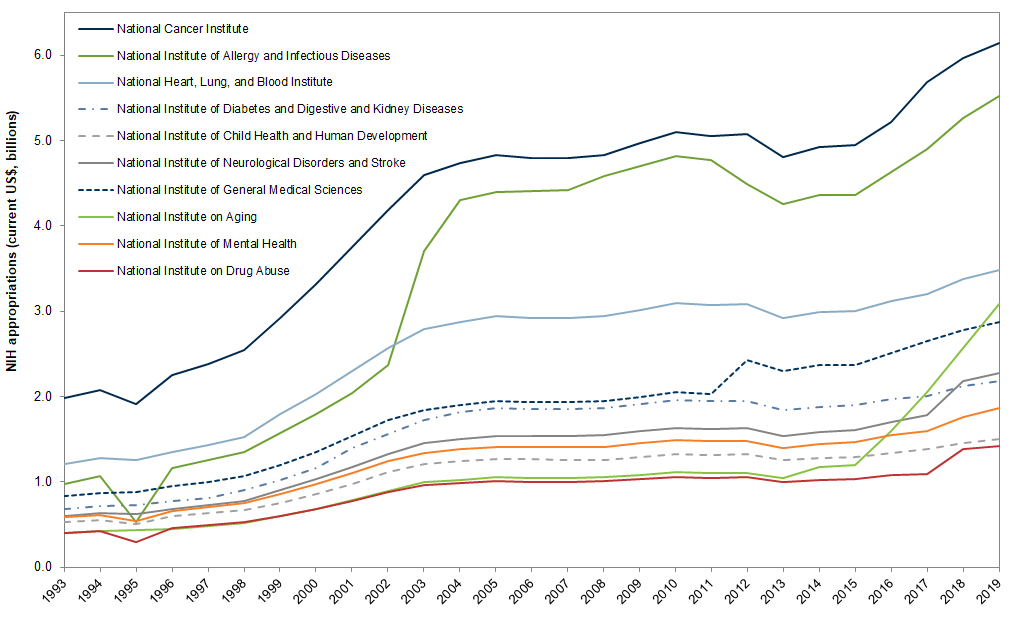
- Distinct divisions gradually proliferated, from 4 groups in 1949, to 10 by 1960, to 15 by 1970, to 27 in 1998.
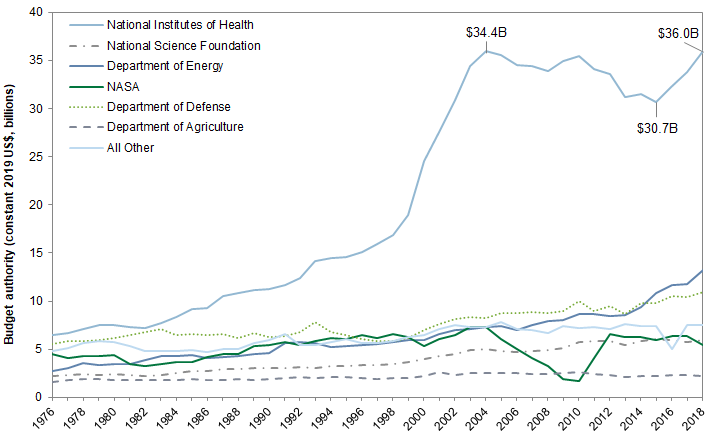
The big bump for the NIH budget doubled in 1998-2003, and then has been flat since then. This rocked biomedical research in ways good and bad that are still being felt today.
Relevant graphs